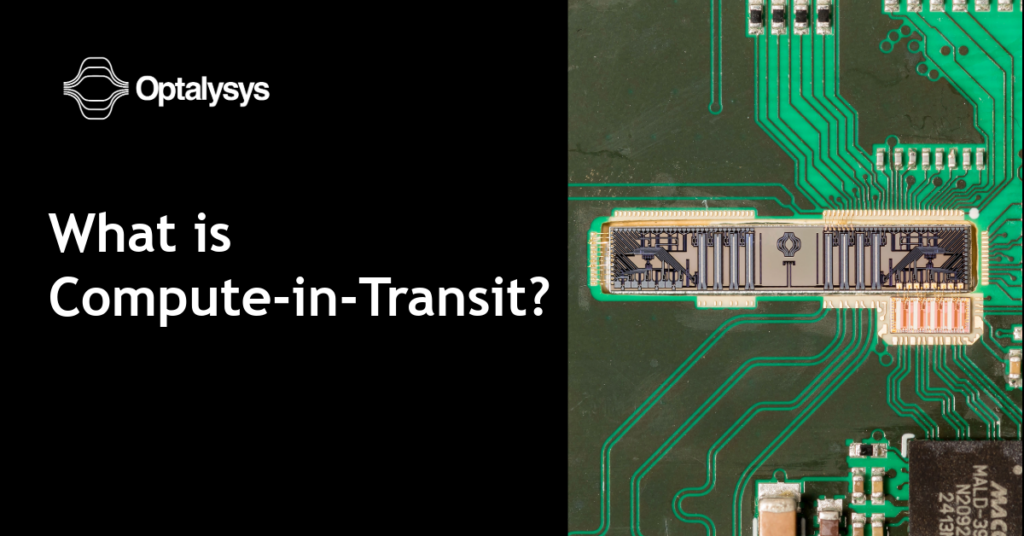
Compute-in-Transit: Direct-drive photonics for compute enabled interconnects

by Imon Kundu
Director of Photonics at Optalysys
Inference times are becoming increasingly limited by the amount of data that must be frequently moved between memory and processors. To help meet the increasing demands, optical interconnects are being deployed to replace the conventional copper-based links, allowing higher bandwidths to be achieved at greater efficiencies.
Computing on data in motion
We have developed an analog processing technology that directly integrates into the optical data path to allow math functions to be performed whilst the data is in motion. Since the data has already been converted into an optical format, the processing is conducted with minimal additional energy to the optical link budget.
The photonic technology is proven in silicon, programmable and configurable. The current design provides 2.68pJ/bit (excl. laser) at 32 GSps per lane; future designs will compute at an efficiency of 215TOPS/W at 112Gsps per lane and beyond.
The technology may be applied in the context of both communication and processing, creating a maths toolbox that can operate on serial streamed data at the line rate of the optical path.
This paper describes the linear-drive physical layer (PHY) technology developed by Optalysys, which performs arithmetic functions on data whilst it is transmitted over an optical link. The PHY is implemented in the physical medium attachment (PMA) sublayer and operates in one of two modes: In interconnect mode it behaves as a conventional transceiver and is backward compatible with existing transceiver solutions. In compute mode the same optical and analog hardware, together with additional custom logic, performs arithmetic on the transmitted data.
At Optalysys we’re pioneering the architectural revolution enabling photonic compute-in-transit. Get in touch with us to find out how we can bring efficiency gains to your use case →
Want more like this delivered straight to your inbox?
Subscribe to stay in the loop