AI efficiency starts with the data path
The AI infrastructure conversation has long been dominated by peak compute: more accelerators, higher operation counts, and larger clusters. But as systems scale, adding more compute power alone does not guarantee proportionally greater performance.
Modern accelerators can only deliver value when they are continually supplied with model weights, activations, and Key-Value (KV) cache data. When memory bandwidth and interconnects cannot keep pace, expensive GPUs and XPUs are left waiting – consuming power, rack space, and capital while delivering lower useful throughput.
The infrastructure of AI itself is being fundamentally redesigned around these constraints – a signal reinforced by Marvell and Penguin Solutions’ recent announcement of a collaboration to tackle memory inefficiencies in data centers.
Extending memory beyond the package
Marvell and Penguin Solutions are developing an architecture that combines Compute Express Link (CXL) memory expansion with multi-rack photonic memory pooling. The goal is to allow CPUs and GPUs to access large pools of disaggregated High Bandwidth Memory (HBM) and DDR5 over silicon-photonic links.
Penguin’s planned MemoryAI Photonic Appliance targets 57.6 Tbps of total bandwidth, supporting up to 576 GB of HBM3E and 16 TB of DDR5 per appliance. Using CXL and Marvell’s Photonic Fabric, applications can access this capacity as shared memory rather than explicitly copying data between separate storage and compute nodes.
Those figures remain design targets, with customer sampling scheduled for 2027, but the architectural direction is unmistakable.
HBM delivers the bandwidth accelerators demand, but it must sit tightly coupled to the processor package – leaving capacity constrained by package area, power limits, and silicon I/O. Copper interconnects can extend reach further, yet signal loss, energy draw, and signal-conditioning overheads escalate rapidly as bandwidth and distance increase.
Photonics changes that physical equation. Optical links extend high-bandwidth access across boards, servers, and racks without incurring distance-dependent electrical penalties, allowing memory capacity to scale independently from compute.
From a compute problem to a dataflow problem
This shift reflects a broader change in how AI efficiency is measured across the data center.
An accelerator capable of extraordinary theoretical throughput still delivers poor system economics if it stalls waiting for inputs, repeats redundant operations, or shuttles the same data across multiple tiers of memory and storage.
Longer context windows and agentic workflows only make this bottleneck worse:
- Expanding KV caches: During inference, KV caches can grow into hundreds of gigabytes or more as context lengths scale
- Persistent multi-agent state: Agentic workloads require retaining, sharing, and reusing state across extended, multi-step tasks
To support these workloads, infrastructure needs more than raw capacity – it requires efficient ways to locate, move, and prepare data before it reaches the processor. Marvell and Penguin’s architecture recognizes that memory and interconnect can no longer be treated as passive supporting layers. They must be co-designed alongside compute as part of a single, unified system.
The next step: compute within the data path
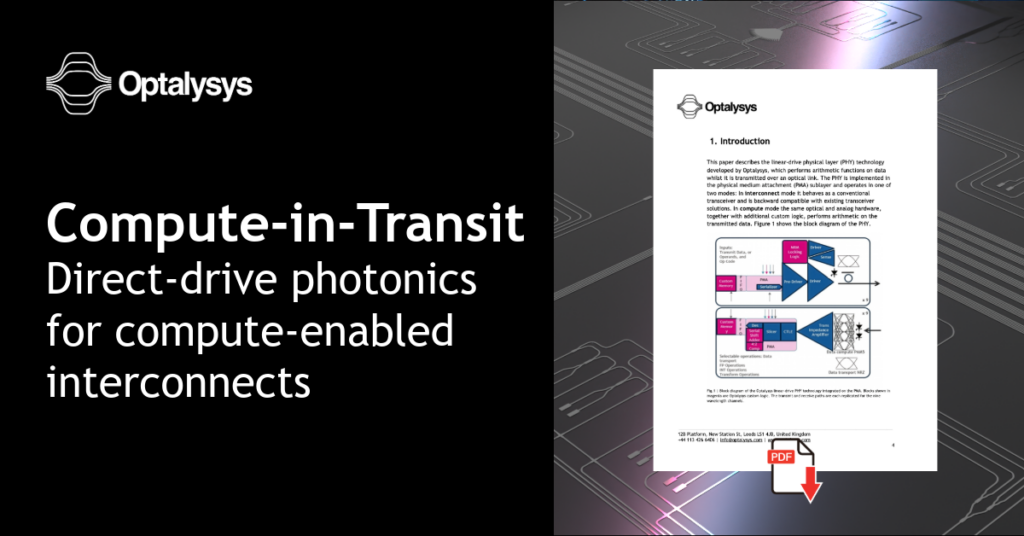
Optalysys’ Compute-in-Transit architecture starts from the same foundational observation: data movement has become a first-order constraint on AI performance, cost, and energy consumption.
Photonic memory fabrics solve a critical part of this problem by making larger pools of disaggregated data accessible at higher bandwidth over longer distances. Compute-in-Transit asks the next logical question: if data must move across optical links, what useful work can happen along the way?
Rather than treating optical transport as a passive pipe – delivering every byte to a conventional processor before any computation takes place – Optalysys uses a hybrid photonic-electronic architecture to embed structured mathematical operations directly within the optical data path. While GPUs and XPUs remain dedicated to dense matrix arithmetic and digital electronics handle control and precision management, Compute-in-Transit can filter, convert, reduce, or transform data while it is in motion.
The two approaches are naturally complementary:
- Disaggregated photonic memory expands the pool of data available across racks without electrical reach penalties
- Photonic Compute-in-Transit ensures that only the required data – or a more compact, workload-ready representation of it – continues through to constrained memory and accelerator resources
By reducing unnecessary memory accesses, easing interconnect bandwidth pressure, and removing preparatory work from the XPU, Compute-in-Transit helps keep expensive accelerators fed and productive. The goal is to extract more useful computation from every movement of data.
AI efficiency requires an architectural revolution
The broader significance of Marvell and Penguin Solutions’ announcement extends well beyond a single memory appliance: it reflects an ecosystem moving decisively toward heterogeneous infrastructure, where accelerators, memory tiers, optical interconnects, and specialized processing are co-designed around real workload behavior.
Photonics overcomes the limits imposed by electrical reach and bandwidth; Compute-in-Transit extends that advantage by turning the data path from an unavoidable overhead into an active computational resource. It is novel architectural redesigns like this that will enable us to scale intelligence efficiently enough to sustain.
With power efficiency the leading constraint, the next era of infrastructure will be defined by how effectively every layer of the architecture contributes to useful output per watt.
At Optalysys we’re pioneering smarter data movement for AI through Compute-in-Transit Get in touch with us to find out how we can bring efficiency gains to your use case →
Want more like this delivered straight to your inbox?
Subscribe to stay in the loop